
A PhD research proposal is a short plan of your project. It sets out the question, why it matters, how you’ll answer it and how long it will take. At the eight UK universities where we found a total length, stated lengths ran from 250-350 words to around 4,000, so check your department’s limit.
Whether you need one at all depends on your route. If you’re putting forward your own project, it’s usually central to your application. If you’re applying to an advertised project, you may not need one.
If your first draft feels overwhelming, that’s normal at the start. Below, we show you how to check which route applies, then cover each section, the timetable and the problems that sink a proposal.
Do you need a research proposal for a PhD?
You’ll usually need a PhD research proposal if you’re designing your own project, and often won’t if you’re applying to an advertised one. An advertised project is one a university, funder or supervisor has already defined. Read the advert or course page before you write anything, because the rules can differ even between departments of one university.
| Your route | What to expect |
|---|---|
| Your own project | A proposal, and usually a central part of your application. It may only need to be an outline at first |
| An advertised project | Often no proposal. You may write a short personal statement about why you suit the project instead. But some advertised projects do ask for a proposal, and a project leader may ask for one |
| A science research group or named project | Sometimes no proposal at all: you name the project, groups or supervisors you’d like to work with, and perhaps write a personal statement |
Source: UK university admissions pages, checked 3 November 2026 (linked in this article or listed under Sources).
Sending one you don’t need won’t help you: it can simply be removed from your application.
Common mistake: assuming science means no proposal. Fully funded advertised projects tend to be in STEM subjects and medicine, but some science departments still want a written plan. Imperial’s computing department, for example, asks every applicant for a three- to four-page research statement.
If you’re on the advertised route, our guide to the PhD motivation letter compares it with a personal statement and a cover letter.
Funding can change the answer too. A scholarship can ask for a proposal even where your course doesn’t: Gates Cambridge, for example, does.
How long should a PhD research proposal be?
Use the length your department states, because there’s no national standard. If you can’t find a limit, ask the department or a potential supervisor. If you still have nothing to go on, aim for 1,000-2,000 words, a common range for a good proposal.
Limits vary most by subject. Science and computing departments tend to ask for the shortest proposals, and the longest we found were in the social sciences and business:
| Subject area | Limits we found |
|---|---|
| Science, engineering, computing, health and psychology (7 departments) | From 250-350 words up to 1,000-2,000 words, or two to four pages |
| Social sciences, education, law and business (14 departments) | From about 1,000-1,500 words up to around 4,000, or up to six pages |
| Arts, humanities and geography (10 departments) | From up to 1,000 words to about 2,500 |
Source: UK university and department guidance pages, checked 3 November 2026 (linked in this article or listed under Sources).
The two ends of that range are at one university. York asks for 250-350 words in physics, engineering and technology, and around 4,000 in business and society. So don’t stretch a science proposal to 3,000 words because a general guide says that’s normal. York’s department-by-department guidance is worth a look for exactly that reason, whichever university you’re applying to. Its computer science section also includes a proposal template.
Limits can be enforced. A proposal that runs over may be returned to you, and one that runs well over may be removed, leaving your application incomplete.
What counts towards the limit varies too. Some departments count references and some don’t, and a department may also count footnotes, appendices, figures and tables. Check what’s included before you start cutting.
What should a PhD research proposal include?
The guides we compared share a core: a title, your methods and, in most, a timetable. Of the seven general and school guides we looked at, all seven list a title and methods, and five list a timetable. Subject lists can differ even within one university, so check the list for yours.
What each section does
Use your department’s order if it gives one. Where your school provides a template, use it: an application that doesn’t may be rejected. If nobody gives you a structure, this order works. The example project is invented, purely to show what each section does.
| Section | What it does | Example: invented project on river pollution |
|---|---|---|
| Working title | Places your project in its field and names the issue | ‘Can low-cost sensors track nitrate pollution in upland rivers?’ |
| Background and gap | Shows why it matters and what’s missing | Say what current monitoring does, and name what it can’t yet show |
| Questions and aims | States what you’ll find out | One main question, with sub-questions on accuracy, cost and placement |
| Existing research | Discusses the key work and how you’ll build on it | Group the main studies by what they tested, then point to the gap |
| Methods | Explains how you’ll answer the question, and why this way | Field sites, comparison with laboratory samples, how you’ll analyse the data |
| Ethics and practicalities | Covers approvals, access, equipment and likely problems | Permission to use the sites, what equipment you’d need, what you’d do if a site floods |
| Timetable | Shows it fits the time allowed | The stages by six-month period (see below) |
| References | Lists what you’ve cited | Only the works central to the proposal |
Five of these sections need more explanation:
- Title: it’s a working title, so you aren’t committed to it. Keep it short: 20 words or fewer is a useful test.
- Questions and aims: aims are the broader statement of what the PhD will do, and questions are what drives it. How many you’ll need varies, from one main question with sub-questions to three to 10 questions or aims, so check your department’s guidance. Our guide to aims and objectives shows how to write them.
- Existing research: this isn’t a full PhD literature review. You won’t have room to analyse everything, so choose the key papers and show how your project fills a research gap: something existing research hasn’t answered. Don’t simply describe the field; say how the key texts support, extend or challenge your work.
- Methods: this can be the longest section. You may be able to propose methods you haven’t used yet, because PhD students get training in them.
- References: keep the list short and include only works central to your proposal. Suggestions we found run from up to 10 references to 10-20. Use a recognised style for your subject, such as Harvard or Vancouver in the sciences.
Add an abstract only if your department asks for one. Only one of the seven guides lists it, though Germany’s DAAD includes one in its checklist. A department may also ask for a separate short summary.
Common mistake: writing up the answer. Your proposal sets out the question and how you’d tackle it. Answering the question is what your research will do.
Use clear headings and short paragraphs. Before you submit, check your spelling, keep the style consistent and make sure your references are accurate. It’s easy to miss errors in your own work, so ask someone else to proofread it.
PhD research proposal examples and templates
Real proposals show you what the finished thing looks like. Sheffield publishes successful sample PhD proposals, and Manchester posts examples by subject. Both come from social sciences schools, so ask your department for something closer if you’re in STEM.
For a suggested structure, see Edinburgh’s guide to writing a research proposal.
Still looking for a project idea? Start with our guide to how to choose a PhD topic.
How to write a research proposal timeline
Your PhD research proposal timeline needs to show the stages of your project and that they fit the time allowed. Start by checking that time, because it isn’t the same everywhere.
Most of the guides we read plan for three years full-time. Some allow three and a half, for example on some scholarship routes. Part-time periods ran from five or six years to seven.
Six-month blocks work well, and a department may ask for them. A plan for each year or a Gantt chart also works. A Gantt chart shows each stage as a bar across time, like this one, which runs to nearly four years:
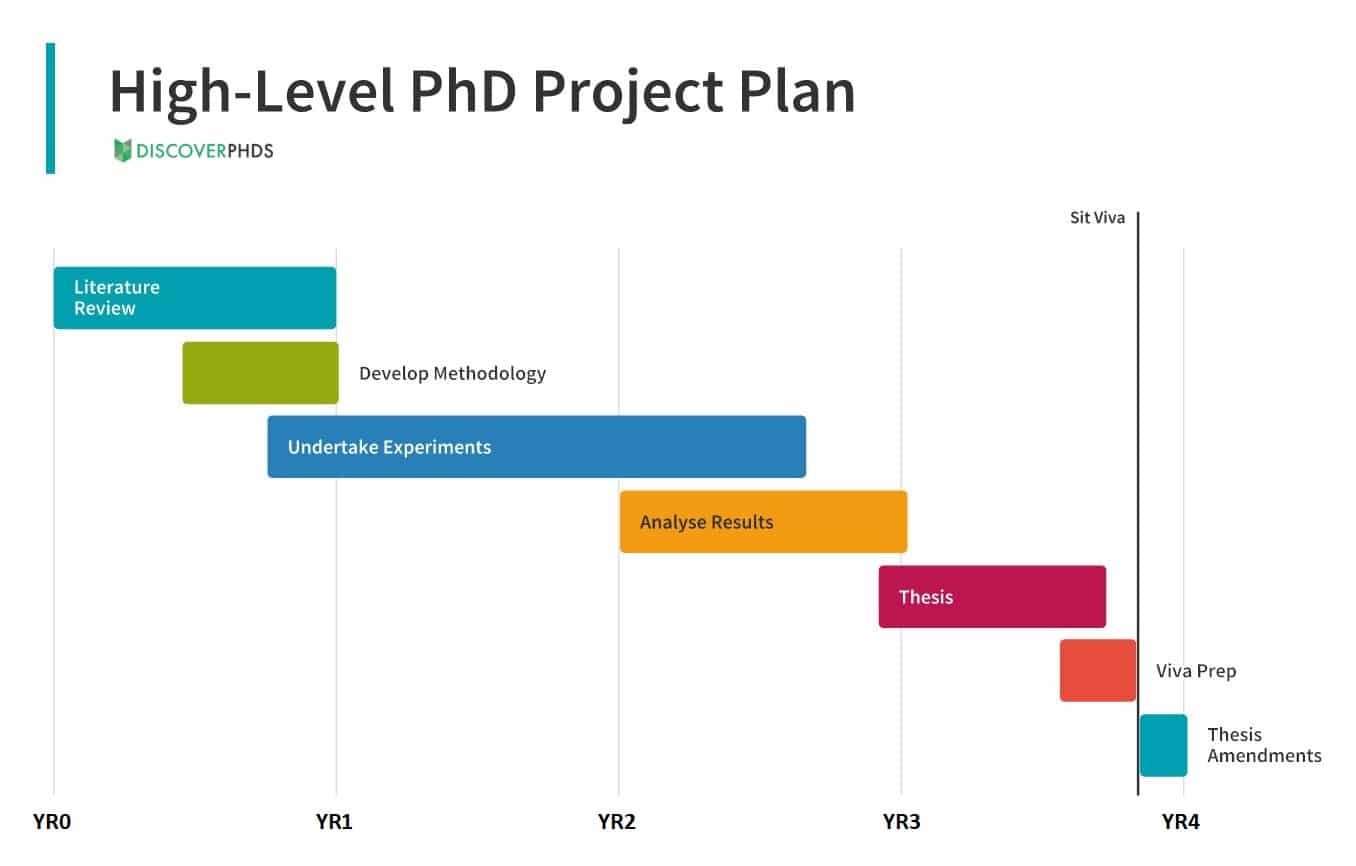
If you’d rather use a table, adapt this three-year PhD work plan. Treat it as a research plan template, not a rule. It suits a project that collects new data:
| Period | Stages |
|---|---|
| Months 1-6 | Refine the questions, start the literature review, complete training, apply for ethics approval |
| Months 7-12 | Pilot the methods, finish the first literature review, start collecting data |
| Months 13-18 | Main data collection, first analysis |
| Months 19-24 | Finish collecting data, analyse results, draft the first chapters or papers |
| Months 25-30 | Finish the analysis, draft the remaining chapters |
| Months 31-36 | Complete the thesis, revise it with your supervisor, submit it and prepare for your viva (the oral exam) |
If you’re applying part-time, stretch the stages across your university’s part-time period, and check the figure, because it isn’t always double. Our guide to how long a PhD takes gives typical UK full-time and part-time lengths. You can also read more about what a PhD involves at each stage.
Common mistake: leaving too little time at the end. Plan back from your intended finish date, and don’t underestimate how long it takes to turn drafts into a finished thesis.
What do universities look for in a research proposal?
Universities use your proposal to answer four questions, and the admissions guidance we read keeps coming back to them:
- Can it be done? Can the project be finished in the time, with the resources available?
- Can they supervise it? Does the department have the expertise to support it?
- Does it add something? Is it original, and do you understand the existing research?
- Can you do it? Are you the right person, with the right skills?
Fit can matter as much as the idea. A university can turn you down if it has no supervisors in your area or lacks the resources. It can also refuse a topic it doesn’t think can be covered in time.
So a strong idea can still fail at a university that isn’t the right home for it. Look up the department’s research before you write, and say how your project connects to it.
A weak PhD research proposal can cost you a place, even with good grades. Applicants who meet the academic requirements can still be turned down for an unsatisfactory proposal. Avoid a proposal that’s poorly specified, full of jargon or rambling.
That doesn’t mean your idea has to be Nobel-worthy. Your hypotheses and reasoning do need to be sound.
Should you ask a supervisor to read your PhD proposal?
Yes, if your course allows contact, because feedback from a potential supervisor is one of the most useful things you can get. Discuss the contents with them before you submit if you can. Some departments recommend developing the proposal with a potential supervisor, or even expect it, and working on it together can make it much stronger.
How much help is fine varies, though. Some universities encourage discussion but say the content must be your own, so check your department’s guidance before a supervisor drafts anything with you.
Three things to watch:
- Check you’re allowed. Make sure the course page recommends or permits contact, because the process varies by programme.
- Don’t send the same draft to everyone. Asking several potential supervisors to comment on the same draft isn’t good practice, and if you’re contacting more than one, say so.
- Don’t count on one supervisor. The person you first contacted may not end up supervising you.
Timing varies too. Depending on the programme, you may need the proposal written before you make contact, or you can ask for feedback once you’ve built a relationship. Our guide on how to email a potential supervisor covers that first message. If you can’t reach a supervisor, ask another academic, such as one at your current or previous university.
Can you use AI to write a PhD research proposal?
Don’t let AI write it. Rules on how far you can use it differ, but submitting AI-generated text as your own can count as academic misconduct. Your proposal must be your own work, and it may be screened for plagiarism.
The rules we found range from no generative AI help at all, through an assistive role only, to limited use that you evaluate and cite. Your university may also have a policy on AI in postgraduate applications, so check it before you open a chatbot.
The proposal is meant to show how you think, so a polished text you can’t defend at interview won’t help you.
Is a funding proposal different from a research proposal?
It can be. Funders have their own preferred formats, so you may need to rewrite your proposal to fit, and their applications may have different requirements. Read the funder’s rules closely: proposals can be rejected simply for breaking them, including on font size or number of pages.
A funder’s readers may not be experts in your field either, so write the summary for someone outside it. That’s why some funders ask for a lay summary, one written for non-experts.
If you’d rather not write a funding proposal at all, consider an advertised project with funding attached. Studentship funding is often attached to a specific project, and our guide to PhD studentships explains how they work. Check each advert for what the funding covers and whether it still asks for a proposal.
Can you change your research proposal after you apply?
Sometimes, but not freely. You may not be able to edit your proposal once you’ve submitted your application. After an offer, changing your topic may not be possible either: a change can need a committee’s approval, based on whether the new topic is feasible. If your funding is tied to the topic, you may have little scope.
Refining the plan is a different matter. Once you start, your project will normally develop. You’ll normally refine it with your supervisor in the early months, and the proposal isn’t a commitment to that exact work.
So write the proposal you can do now, and don’t worry about getting every detail final. If you know the topic itself may change, raise it with the department before accepting an offer.
PhD research proposals outside the UK
The answer changes by country. In Germany you’ll usually need a proposal, but the US PhD pages we read ask for a statement of purpose, about your preparation and goals, instead. So check the rules wherever you’re applying.
- Germany: DAAD, Germany’s academic exchange service, says in an undated guide that you’ll usually be asked for a proposal, because individually led research is still the norm in most subjects. Most run to 4-15 pages, and it says a full one is rarely possible in under 1,500 words. Even on an established project, you’ll probably need to explain how your research would develop its aims.
- Australia: expectations vary widely, from a one-page maximum to a 3,000-word minimum depending on your supervisor and research area, so ask your supervisor. At the University of Sydney, for example, it’s usually no more than 2,000 words.
- US: the three PhD admissions pages we read ask for a statement of purpose and don’t mention a research proposal. That’s three examples, in computer science, statistics and information science, not a national rule. A statement of purpose covers your preparation, interests and goals rather than a full project plan, though you may still be asked to name the staff you’d like to work with.
Your next step
Start with the route. Find your advert or course page, and note the word limit and what counts towards it. Then look up who could supervise you and, if your course allows it, email them a short outline. Once you’ve got that, you can draft your PhD research proposal in the order above.
If you haven’t settled on a project yet, use the search box below to browse current PhDs. An advertised project might save you writing a proposal at all.
Sources
- University of Birmingham: Do I need to submit a research proposal for a PhD application?
- University of Reading: How to apply
- University of Reading: Writing a research proposal (2025)
- University of Sussex: Writing your research proposal
- University of Oxford: Research proposal
- University of Oxford, School of Geography and the Environment: Guidelines to writing a research proposal
- University of Edinburgh: Advertised PhD research projects and other opportunities
- University of Edinburgh: Writing a research proposal
- University of Cambridge: Writing a research proposal
- University of Cambridge, Faculty of Education: Writing a research proposal
- University of Brighton: How to write a research proposal for a PhD application
- Imperial College London, Department of Computing: PhD application guidelines
- DAAD: How to write a research proposal
- University of Sydney: How to write a research proposal
- University of Queensland: How to write a research proposal
- Stanford University, Computer Science: PhD admissions FAQs
- Stanford University, Statistics: PhD admissions requirements and procedures
- UC Berkeley, School of Information: PhD admissions