Understanding UK academic titles
If you’re starting a PhD or considering an academic career, understanding UK academic titles is one of the first things you should get to grips with. Who outranks whom? What’s the difference between a lecturer and a professor? And where do postdocs fit into the picture?
The academic hierarchy in UK universities can feel confusing, partly because not every institution uses the same titles. Several Russell Group universities – including the University of Oxford, UCL and the London School of Economics – have adopted their own variations. Despite this, the core structure remains broadly consistent across the sector.
In this guide, we’ll walk you through every level of the UK academic hierarchy, from PhD student right up to faculty dean. For each position, we’ll explain what it involves, where it sits in the ranking and what you can expect to earn.
UK academic ranks at a glance
Before we go into detail, here’s a quick overview of the main academic ranks in the UK, listed from most junior to most senior:
| Rank | Typical Salary Range | US Equivalent |
|---|---|---|
| PhD Student | £21,805 stipend (UKRI rate, 2026/27) | Graduate Student |
| Postdoc Research Fellow | £40,000-£45,000 | Postdoc |
| Teaching Fellow | £40,000-£45,000 | Instructor / Lecturer |
| Lecturer | £42,000-£59,000 | Assistant Professor |
| Senior Lecturer | £56,000-£70,000 | Associate Professor |
| Reader | £56,000-£70,000 | Associate Professor (research focus) |
| Associate Professor | £56,000-£70,000 | Associate Professor |
| Professor | £72,000-£95,000+ | Full Professor |
| Named Professor | £95,000-£150,000+ | Endowed Chair |
| Head of Department | Varies by institution | Department Chair |
| Faculty Dean | Varies by institution | Dean |
Salaries are approximate and based on typical UK university 2025/26 national pay spine scales. Actual figures vary between institutions and regions. For more detail on PhD student income, see our guide to PhD salary and stipend in the UK.
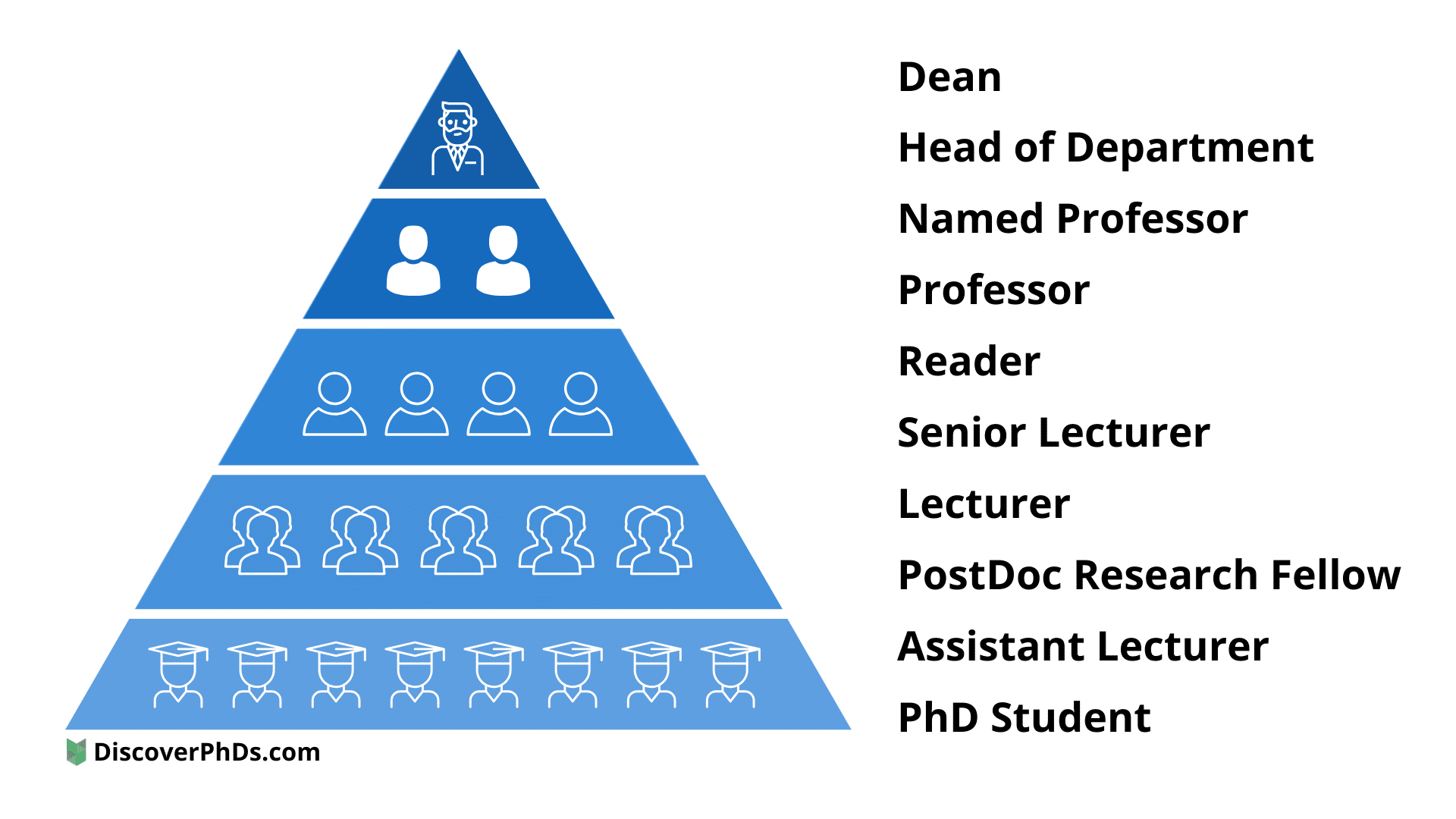
PhD student
A PhD student is a postgraduate researcher who is actively working towards a doctoral degree at a recognised institution.
Most full-time PhD students spend three to four years completing their degree, though part-time students may take six to seven years. During this time, they carry out original research, write a thesis and defend their work in an oral examination known as a ‘viva‘.
PhD students also attend seminars, present at conferences and collaborate with other researchers. Some take on teaching responsibilities as Graduate Teaching Assistants (GTAs), which involves leading tutorials, marking coursework and supporting laboratory sessions.
Once you successfully complete your doctorate, you earn the title of Doctor (Dr). This applies regardless of your discipline. It’s also worth noting that ‘PhD student’ covers anyone pursuing a doctoral degree, whether that’s a PhD, DPhil, DBA, EdD, EngD or another variant.
Postdoc research fellow and research assistant
A postdoc research fellow or research assistant is someone who has completed their doctorate and is working in a research role. This is typically the first career step after finishing a PhD.
The two titles differ mainly in independence:
- Research assistants work under the direction of a principal investigator (PI) and carry out tasks within a defined project.
- Research fellows have greater autonomy to shape the direction of their research and often lead specific aspects of a project.
Postdoc positions are usually fixed-term contracts lasting one to three years. They provide valuable experience but can feel precarious, and many researchers hold several postdoc positions before securing a permanent academic role.
For a deeper look at this career stage, see our guide to postdoctoral research positions.
Teaching fellow and senior teaching fellow
Not all university positions in the UK follow the traditional research-and-teaching path. Many Russell Group universities now offer dedicated teaching-track roles.
- Teaching fellows focus primarily on delivering lectures, seminars and tutorials. They may also design course materials and support student assessments.
- Senior teaching fellows take on additional responsibilities such as programme leadership, curriculum development and mentoring junior teaching staff.
These roles sit at a similar pay grade to lecturers and senior lecturers respectively, but with a stronger emphasis on teaching rather than research output. Additionally, recognition from Advance HE (formerly the Higher Education Academy) is increasingly expected. Fellowship or Senior Fellowship status signals teaching quality and is often a requirement for promotion.
Lecturer
A university lecturer is the first rung of the permanent academic career path in UK universities. If you’re wondering about the difference between a lecturer vs professor, the simplest answer is that lecturers are junior academic staff while professors sit at the very top.
Lecturers split their time between teaching and research. Their day-to-day responsibilities typically include:
- Delivering lectures and seminars to undergraduate and postgraduate students
- Supervising student projects and dissertations
- Conducting their own research and publishing papers
- Carrying out administrative duties within their department
Most lecturers hold a PhD, though this isn’t always the case, particularly in non-STEM fields where extensive professional experience can substitute.
New lecturers usually serve a probation period of three to four years. After successfully completing probation, the position becomes permanent (or ‘tenured’ in US terms). In the US system, a lecturer is roughly equivalent to an assistant professor.
Senior lecturer
A senior lecturer carries all the responsibilities of a lecturer, with the addition of:
- Leading and supervising research projects
- Taking on greater administrative and strategic roles within the department
- Mentoring junior lecturers and research staff
- Contributing to programme leadership and quality assurance
Promotion from lecturer to senior lecturer typically requires a strong track record in both research and teaching, along with evidence of leadership.
Reader
A reader holds a senior academic position with an international reputation for their research contributions. In the academic hierarchy in the UK, readers rank above senior lecturers but below professors.
The key distinction is that readers are recognised primarily for their research excellence and international standing, rather than teaching or administrative leadership. Think of it as being one step away from a full professorship.
A few important notes:
- Universities established after 1992 (sometimes called ‘post-92’ universities) often use the title ‘Principal Lecturer’ instead of Reader.
- At some institutions, senior lecturer and reader are treated as equivalent ranks, with senior lecturer being the teaching-focused title and reader being the research-focused title.
- The University of Oxford has stopped appointing new readers altogether.
Associate professor
In the past decade, a growing number of UK universities have adopted the title ‘associate professor’ to replace senior lecturer or reader. This shift aims to improve clarity for international applicants and align more closely with the US and European systems.
Universities that have made this change include the University of Exeter, the University of Warwick, the University of Reading and Kingston University. Notably, Oxford has replaced ‘lecturer’ with ‘associate professor’ entirely, which can cause some confusion.
Where the title is used, associate professors are typically appointed for an initial five-year period before going through a formal review for reappointment. The role sits between lecturer and full professor in terms of seniority.
Professor
A professor holds the highest permanent academic rank in the UK. Reaching this level signals that an individual has made significant and sustained scholarly contributions to their field.
In EU countries like Germany and France, becoming a professor involves passing an independent review panel. However, the UK takes a slightly different approach. Most universities run an internal promotions process, though many now include external panel members to ensure fairness.
There are two main types of professorship:
- Personal chair: Awarded to an individual in recognition of their outstanding achievements in a specific area.
- Established chair: Created by the university to meet its strategic needs in a particular discipline, then filled through a competitive appointment process.
According to the Higher Education Statistics Agency (HESA), roughly one in 10 academic teaching staff in the UK holds the title of professor. For more on what professors and lecturers earn, see our guide to lecturer and professor salaries.
Named professor
A named professor is a professor who holds a prestigious ‘chair’, a position named after an individual who made significant achievements in the field. Some named chairs date back to the 16th century, making them among the most historic positions in British academia.
Being appointed to a named chair is a mark of exceptional distinction, reserved for academics whose contributions go well beyond the standard expectations of a professorship.
Some universities, such as the University of Sheffield, use the title ‘Honorary Professor’ in a similar way, though the exact meaning can vary between institutions.
Emeritus professor
When a distinguished professor retires, their university may grant them the title of emeritus professor. This is an honorary designation that recognises their career-long contributions.
Emeritus professors no longer hold formal teaching or administrative responsibilities, but many continue to supervise PhD students, collaborate on research projects and contribute to university life in an advisory capacity.
Head of department
The head of department provides academic leadership for their department and is responsible for maintaining its standards and strategic direction. Their responsibilities typically include:
- Overseeing research activity and teaching quality
- Managing the department’s budget and resources
- Supporting staff development and promotions
- Ensuring effective communication across the department
The scope of this role varies depending on the size of the department. Heads of department are usually serving professors, though the position is often rotated among senior staff every three to five years.
Faculty dean
A dean oversees the academic administration of a faculty, which is a collection of related departments. This is a senior leadership role that combines academic authority with significant managerial responsibility.
Key responsibilities include:
- Representing all permanent staff members within the faculty
- Leading strategic planning for the faculty’s direction and growth
- Participating in internal review panels for staff promotions
- Facilitating research initiatives and cross-departmental collaborations
- Reporting to the provost or vice-chancellor on faculty performance
Deans are typically appointed through a formal search committee process and must be serving professors.
UK vs US academic titles compared
One of the most common sources of confusion is how UK academic ranks map onto the US system. Here’s a side-by-side comparison:
| United Kingdom | United States |
|---|---|
| PhD Student | Graduate Student |
| Postdoc | Postdoc |
| Lecturer | Assistant Professor |
| Senior Lecturer / Reader | Associate Professor |
| Professor | Full Professor |
| Named Professor | Endowed Chair |
The biggest difference is at the entry level. In the UK, ‘lecturer’ is a junior academic title. In the US, however, ‘lecturer’ often refers to a non-tenure-track teaching position. Similarly, ‘professor’ in the UK is reserved for the most senior academics. In the US, it can refer to anyone from an assistant professor upwards.
Career progression: how to move up the academic ladder
Understanding the university positions in the UK is one thing. Knowing how to advance through them is another. Here are the typical promotion pathways:
- PhD to postdoc: Most graduates move into one or more postdoc positions before applying for lectureships.
- Postdoc to lecturer: You’ll need a strong publication record, evidence of independent research and ideally some teaching experience.
- Lecturer to senior lecturer: Typically requires three to five years of strong performance in both research and teaching, plus evidence of leadership.
- Senior lecturer to reader or professor: Requires an established international reputation, a significant body of published research and evidence of wider academic contribution.
There are three common routes to promotion from lecturer:
- Internal application: Apply through your university’s annual promotions process.
- External application: Apply for a more senior position at another university.
- Nomination: Be nominated by senior colleagues or your head of department.
For a broader view of career options after your doctorate, read our guide to life after a PhD.
Frequently asked questions
What is the highest academic title in the UK?
The highest academic title is professor. Named professors (those holding an endowed chair) represent the most prestigious tier within the professoriate.
Is a reader higher than a senior lecturer?
At many universities, yes – a reader is considered more senior, with the distinction being a stronger international research reputation. However, some institutions treat the two titles as equivalent ranks on different career tracks (research vs teaching).
What is the difference between a lecturer and a professor in the UK?
A lecturer is a junior academic who primarily teaches and conducts research. A professor is the most senior academic rank, reserved for individuals who have made significant scholarly contributions to their field. Between the two sit senior lecturers, readers and associate professors.
Are associate professors the same as senior lecturers?
In practice, many UK universities now use ‘associate professor’ as a replacement for ‘senior lecturer’ or ‘reader’. The responsibilities are broadly similar, but the title is more widely understood internationally.
Summary of UK academic titles
The UK academic titles system runs from PhD student through postdoc, lecturer, senior lecturer, reader and professor, with administrative leadership roles like head of department and faculty dean sitting alongside. While university positions vary between institutions, the underlying structure of the UK higher education system remains consistent.
If you’re at the start of your academic journey, understanding these titles will help you navigate university life and plan your career path. Ready to take the first step? Search for PhD opportunities on DiscoverPhDs to find a project that matches your interests.