
In the UK, a PhD thesis usually has an upper limit of 75,000 to 100,000 words, not counting the bibliography. All five UK universities we checked put their standard PhD limit or guideline in that range. As for pages, the largest count we found puts a typical thesis at about 200 pages of main text. Across 1,000 theses at the University of Auckland, the median was 198.
So how long is a PhD thesis for you? The answer depends on your university, your faculty and the format of your thesis, and the limit is a ceiling rather than a target. Below, we set out the usual limits, what counts towards the word count, and what happens if you go over. (If you’re asking how long the degree itself takes, see our guide to how long a PhD takes.)
What is the word limit for a PhD thesis?
Your university sets the limit. At the five UK universities we checked, the standard PhD limit or guideline falls between 75,000 and 100,000 words. Three of them set one limit for all subjects, and two set figures by faculty:
| Your situation | PhD word limit or guideline |
|---|---|
| University with one limit for all subjects | 75,000 or 80,000; a faculty may set a higher limit for a specific discipline |
| Arts and humanities | 75,000 to 100,000 |
| Social sciences | 75,000 to 100,000 |
| Health and medical sciences | 75,000 to 80,000 |
| Science, agriculture and engineering | 80,000 |
Sources: regulations or thesis guidance from five UK universities, checked 30 October 2026 and listed in the Sources list below. The oldest dated one is a guide last updated in July 2021.
The range is narrower than it looks. Most of these limits sit at 75,000 or 80,000 words. Only two of the five go as high as 100,000, and then only for humanities or social sciences.
Two details sit outside the table. A university may set no university-wide limit at all and leave it to faculty guidelines. And integrated PhD programmes can have lower limits, such as 80,000 words in humanities and social sciences and 50,000 in science, agriculture and engineering.
Your own figure is in your university’s research degree regulations or your faculty handbook.
What counts towards the PhD thesis word count?
At all five universities we checked, the main text counts and the bibliography and appendices don’t. Where they differ is footnotes:
- Footnotes don’t count at three of the five.
- Footnotes do count at the other two, where the rules use wording such as ‘inclusive of notes’ or say the main body includes ‘references, citations, footnotes, and data’.
Tables may be left out of the count too. Appendices aren’t always a free pass, though: a university may cap them, for example at 5,000 words in total unless you get permission to go further. So check before you move half a chapter into an appendix to save words, and see what belongs in thesis appendices.
Common mistake: assuming footnotes are free. If your discipline relies on long notes, check your rules early, because at some universities every one of those words counts.
Does the word limit depend on your subject?
At some universities, yes. Two of the five we checked set different figures by faculty, and not always in the direction you’d expect: humanities can get more words than science (100,000 against 80,000) or fewer (75,000 against 80,000).
Page counts can split by subject too. In the same University of Auckland count, science theses from 2008 to 2015 came out shorter. That count grouped the science, engineering and medical and health sciences faculties as STEM. In 2015, the median STEM thesis ran to 159 pages of main text, against 223 pages for other subjects.
The count’s author suggests STEM candidates think of their thesis as about 150 pages. Those in social sciences, arts and humanities are, in the author’s words, ‘more likely than not’ to be writing a thesis over 220 pages.
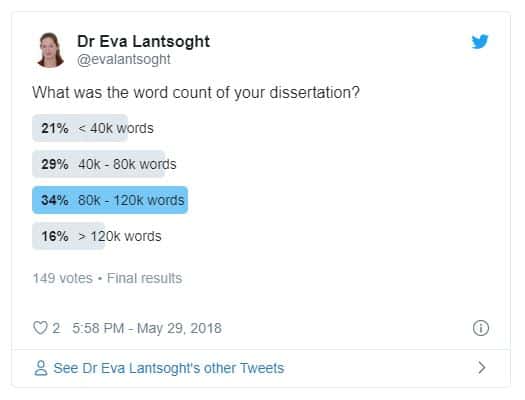
The image above is a screenshot of a 2018 Twitter poll on dissertation word counts, run by Eva Lantsoght. Anyone could answer it, so treat it as a snapshot rather than a rule.
How many pages is a PhD thesis?
In the largest count we found, a typical thesis ran to about 200 pages of main text. Researchers at the University of Auckland counted 1,000 doctoral theses from 2008 to 2017. They counted only the chapters, leaving out the front pages, bibliography and appendices. They found:
- an average of 204 pages, and a median of 198;
- an average of 7.55 chapters, with seven chapters the most common (229 theses);
- just under half (486) between 100 and 199 pages, and 426 between 200 and 299;
- only 23 under 100 pages and 65 over 300.
Page counts depend on line spacing and figures, so use them as a rough guide and work to your word limit.
Is there a minimum length for a PhD thesis?
None of the universities we checked sets a minimum length for a standard PhD thesis, and some say so outright. What matters is whether your thesis makes its contribution, not how long it is.
Two of the UK universities we checked also tell you not to treat the maximum as a goal. In their words, the stated maximum ‘is not a target figure’, and candidates ‘should not feel that their thesis must necessarily be as long as the maximum word limit’.
What this means for you: write until your argument is complete, then edit. A tight 70,000 words is better than a padded 80,000. As our guide to what a PhD thesis is explains, it’s judged on its original contribution to your field.
What happens if your thesis is over the word limit?
Expect to need approval for a longer thesis, normally before you submit: all three UK universities whose rules on this we checked ask for it. Without it, a thesis over the limit may not be accepted for examination, or the examiners may require you to resubmit it within the limit.
Who decides varies. It may be a doctoral college’s academic director, a dean of postgraduate research or a faculty’s graduate school director. You may need to send a statement explaining why, or your supervisors may need to support or recommend the request. Even with approval, examiners may still recommend that you shorten it.
So if you’re heading over, raise it with your supervisor early.
Thesis by publication and practice-based PhDs
Different formats can have different limits. Sheffield Hallam’s regulations show what that can look like. There, an article-based PhD is 60,000 to 80,000 words in total, and the articles are expected to make up 20,000 to 40,000 of that. A creative or practice-based PhD normally has a written thesis of 30,000 to 40,000 words alongside the creative work.
Other universities may set separate limits for practice-based PhDs, such as Fine Art, Music and Creative Writing. If you’re considering a thesis built on published papers, our guide to the PhD by publication explains how that route works.
How long is a PhD thesis outside the UK?
The numbers can look similar, but what counts often differs, so check what’s included before you compare:
- Australia (University of Melbourne, 2023 handbook): its PhD entry for law says a thesis normally runs to 80,000 words. Tables, maps, bibliographies and appendices don’t count, but footnotes do. It shouldn’t exceed 100,000 words without special approval.
- New Zealand (University of Auckland): a 2018 report gives the maximum as 100,000 words, including the front matter, bibliography and appendices.
- United States: a dissertation may have no set length at all. The Richard Gilder Graduate School of the American Museum of Natural History, for example, has ‘no specific minimum or maximum page length requirement’. For a narrative dissertation, it suggests a minimum of about 100 pages.
In the US, ‘dissertation’ usually means the doctoral thesis. Our guide to the difference between a dissertation and a thesis explains the terms.
How does a PhD thesis compare with an MPhil thesis?
An MPhil thesis is shorter, though by how much depends on the university. At three of the five we checked, the MPhil limit is about half the PhD limit. At the other two, it’s two-thirds or three-quarters. Expect an MPhil limit of 40,000 to 60,000 words, with 40,000 the most common figure we found.
If you’re asking how long a thesis is for a master’s by research, the one limit we checked was 40,000 words. Our guide to what an MPhil is covers what the degree involves and how moving between an MPhil and a PhD works.
Next steps
The real answer to how long your PhD thesis should be is in your university’s research degree regulations and your faculty’s guidance. Find them and note three things: the limit, what’s excluded and how to ask for more. Then agree a target length with your supervisor, based on what your argument needs. Once your thesis is in, the next stage is the oral exam: our guide to PhD vivas explains what to expect.
Sources
- University of Warwick: Guide to examinations for higher degrees by research, requirements
- University of Warwick: Word limit
- University of Sheffield: Preparing a thesis
- Newcastle University: Rules for the form of theses and submission of work for higher degrees 2026-27
- University of Southampton: Producing your thesis, a guide for research students
- Sheffield Hallam University: Research degrees thesis guidelines 2025-26
- University of Melbourne: Doctor of Philosophy (Law), handbook 2023
- DoctoralWriting SIG (Ian Brailsford): How many chapters and pages are there in a doctoral thesis?
- American Museum of Natural History, Richard Gilder Graduate School: Doctoral dissertation guidelines