A list of figures for your thesis or dissertation is exactly that: it’s a list of the names of all figures you’ve used in your thesis or dissertation, together with the page number that they’re on.
The list of figures is especially useful for a reader to refer to as it (1) gives the reader an overview of the types of figures you’ve included in your document and (2) helps them easily find a particular figure that they’re interested in.
Where does the list of figures go?
Write your list of figures and list of tables immediately after your list of contents, as in Newcastle University’s thesis guidelines. A separate list of figures belongs in a thesis or dissertation; for a journal manuscript, follow the journal’s own author guidelines.
Important points to remember
Ensure that the figure titles in your list of figures are exactly the same as those used in the main document. Double check that the page numbering is correct and that the font size, margins and all other formatting are correct.
Formatting the list of figures
Starting off, check how your university numbers the pages from the title page onwards. Newcastle, for example, uses lower-case Roman numerals (i, ii, iii) for preliminary pages such as the contents and the lists, then Arabic numbers (1, 2, 3) from the Introduction; the University of Sheffield numbers pages consecutively throughout.
Keep your margins consistent with those of the rest of the document, as required by your university. The binding edge gets a wider margin, but sizes vary: Newcastle asks for 3 cm (2 cm elsewhere), the University of York recommends at least 40 mm (15 mm elsewhere) and Sheffield asks for at least 20 mm (15 mm elsewhere). Our guide to thesis binding and printing covers the binding and printing choices.
Keep the font of the list of figures the same as the main text (12 pt at Newcastle, where all text except headings is 12-point).
Title this section ‘List of Figures’ (in capitals if your university asks), styled like your other preliminary headings such as ‘Contents’.
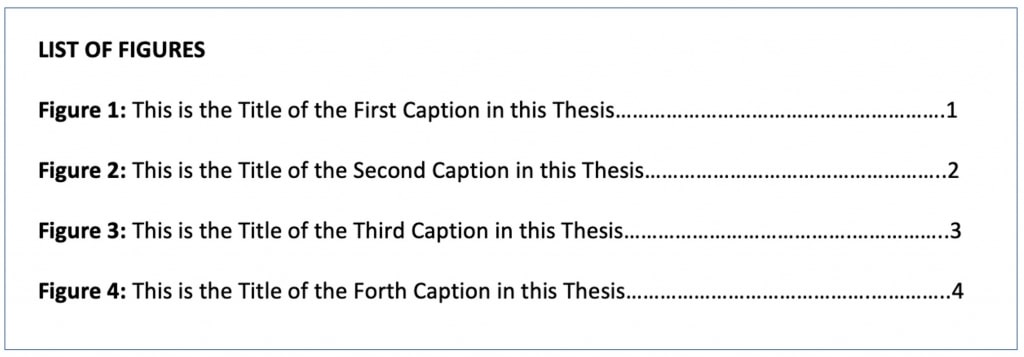
List each figure caption on a new line, worded as it is in the text. Write the figure number on the left, then the caption and finally the page number the figure appears on, on the right-hand side. Our guide on how to write a figure legend covers the captions themselves.
Apply the same formatting principle to the list of tables in your thesis or dissertation. That is, insert each table number on a new line, followed by the table title and its page number.
Example of the list of figures
The example below was created in Microsoft Word (the steps for building one are below). Be mindful of the figure labelling convention required by your university. For example, you may need to align the figure numbers with each chapter (Figure 1.1, 1.2, 1.3 and so on for Chapter 1, and Figure 2.1, 2.2, 2.3 for Chapter 2).
How to create a list of figures in Word
Word calls it a ‘table of figures’ and builds it from your captions (Microsoft’s guide):
- Caption each figure. Select it, choose References > Insert Caption and the ‘Figure’ label, and type the caption (Microsoft).
- Number by chapter, if needed. In the Caption box, select Numbering and tick Include chapter number. Your chapter titles need their own numbered heading style (Microsoft).
- Insert the list. Click where it should go and choose References > Insert Table of Figures.
- Update it before you submit. Click the list, press F9 (or References > Update Table) and choose Update entire table.
Word lists only captions added this way, so captions typed as plain text won’t appear. Use the ‘Table’ label the same way for your list of tables.
How to create a list of figures in LaTeX
Put \listoffigures after \tableofcontents, and \listoftables for the tables. LaTeX takes each entry from the figure’s \caption; you may need to compile twice for the lists to appear properly (Overleaf). For a long caption, \caption[Short title]{Full caption} puts the short title in the list (LaTeX Wikibook).
Our guides to the list of abbreviations and appendices cover other parts of a thesis.